 11
11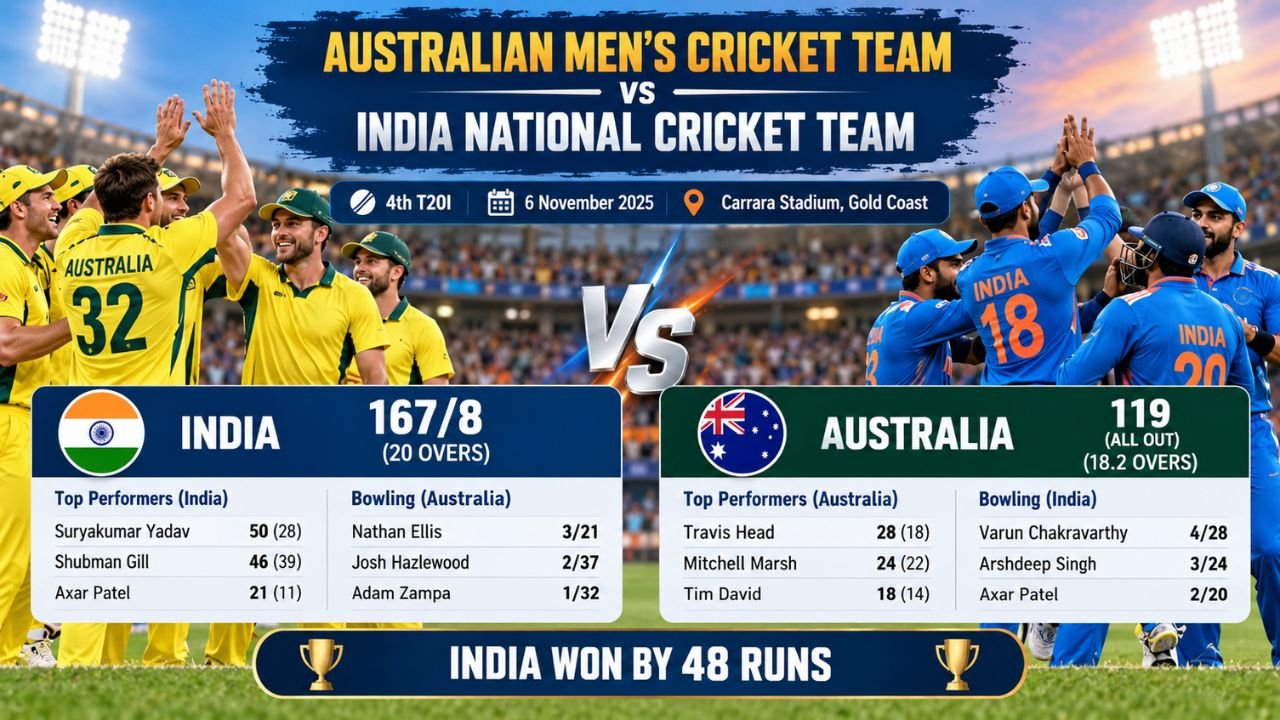
The match scorecard between the Australian men’s cricket team vs India national cricket team is one of the most searched scorecard topics in international Cricket as Australia and India regularly meets in high profile bilateral series and ICC tournaments. Their matches have been characterized by fiercely competitive batting, superb fast bowling and finishing positions coming down to the wire.
They have played against each other in all three formats – Tests, ODIs and T20Is. In their recent ODI series, Australia claimed the first two matches, however India then struck back strongly to secure a nine wicket victory in the third ODI of the 2025 series.
The following table gives a quick overview of a recent ODI meeting between the two sides:
| Match Detail | Information |
| Teams | Australia vs India |
| Format | ODI |
| Series | Australia vs India ODIs |
| Match | 3rd ODI |
| Date | 25 October 2025 |
| Venue | Sydney Cricket Ground |
| Australia Score | 236 all out |
| India Score | 237/1 |
| Result | India won by 9 wickets |
| Winning Team | India |
| Match Type | International ODI |
The third ODI was particularly notable due to India’s successful chase. Australia: 236 all out (47 overs), New Zealand: 237/1 in 38.5 overs (Rohit Sharma 139 not out, KL Rahul 79) India won by nine wickets with Bharat Raj Singh
Also Read: Sri Lanka National Cricket Team vs Pakistan National Cricket Team Match Scorecard
Australia’s Innings end at 236 runs. The visitors managed to make a chasable score courtesy of their bowling unit that contained the Australian batting order.
| Australia Batting | Runs | Status |
| Australian openers | – | Dismissed |
| Middle-order batters | – | Dismissed |
| Lower-order batters | – | Dismissed |
| Extras | – | Included |
| Australia Total | 236 | All out |
However the individual batting figures may differ based on how many balls you watch, where you get your scorecard from and what match presentation, it does not matter for the official end result of the game because Australia will be marked down as all out 236.
India’s bowlers had a major impact in doing all they could to limit Australia’s total. To regularly take wickets denied Australia a score vastly greater than the 71 they accrued in just their second innings.
| Bowling Area | Impact |
| New-ball bowling | Created early pressure |
| Middle overs | Restricted scoring opportunities |
| Wicket-taking | Prevented partnerships from becoming dominant |
| Death overs | Helped finish Australia’s innings |
| Overall result | Australia bowled out for 236 |
A strong bowling performance is often crucial in Australia-India matches because both teams possess deep batting lineups.
India produced a dominant response while chasing Australia’s total. The team scored 237 for the loss of only one wicket, completing the chase comfortably.
| India Batting | Runs/Result |
| Opening partnership | Strong start |
| Top-order batting | Controlled the chase |
| Wickets lost | 1 |
| India Total | 237/1 |
| Overs | Within the available ODI quota |
| Result | Won by 9 wickets |
India had chased down the target of 236 within 17 overs after bowling Australia out for that total, sealing the win by nine wickets.
As Australia languished to create sufficient breakthroughs when India chased down the target. India stays on top for most of the innings while losing just 1 wicket.
| Bowling Phase | Match Situation |
| Opening spell | Australia looked for early wickets |
| Middle overs | India controlled the run rate |
| Partnership bowling | Failed to break India’s main partnership |
| Final phase | India completed the chase comfortably |
| Wickets taken | 1 |
Scorecard for the ODI match between the Australian men’s cricket team and India national cricket team, showing a record Indian win.
| Team | Score | Result |
| Australia | 236 all out | Lost |
| India | 237/1 | Won |
| Winning Margin | – | 9 wickets |
After bundling out Australia for 236, India had registered a nine-wicket win. The result also handed India a 2-1 win in the ODI series.
This match was a function of India’s capacity to take Australia down and chase the total with little punishment.
| Performance Area | Team | Match Impact |
| Batting | India | Dominated the chase |
| Bowling | India | Bowled Australia out for 236 |
| Opening batting | India | Established control early |
| Partnerships | India | Reduced pressure during chase |
| Overall performance | India | Complete nine-wicket victory |
Australia grew into the match with their ODI collective batting philosophy at play, expecting to post a highly competitive total. Nevertheless, the innings never grew into a score big enough to govern.
236 is competitive on certain pitches, but against a strong Indian batting order left little room for error. Australia needed to keep snagging wickets regularly in order to stay in the game, after India began positively on their chase.
This was the main difference between both sides in terms of batting attack. With Australia looking to build pressure, India went for the chase positively and only lost one wicket.
| Factor | India’s Performance |
| Target | 237 |
| Wickets lost | 1 |
| Total reached | 237 |
| Chase outcome | Successful |
| Winning margin | 9 wickets |
This type of chase highlights the importance of a strong opening platform in ODI cricket.
Several factors influenced the final result.
The reckoned target of 236 all out was in by Australia. A score either around 280 or even 300 would have put far greater pressure.
India prudently didn’t take any risks and kept wickets in hand. Only one wicket lost was a big gain.
The Indian chase partnership prevented Australia from bowling a long enough spell to build up pressure.
India came in to chase and Australia really needed early wickets. The visitors a remained firmly in control with just one wicket falling.
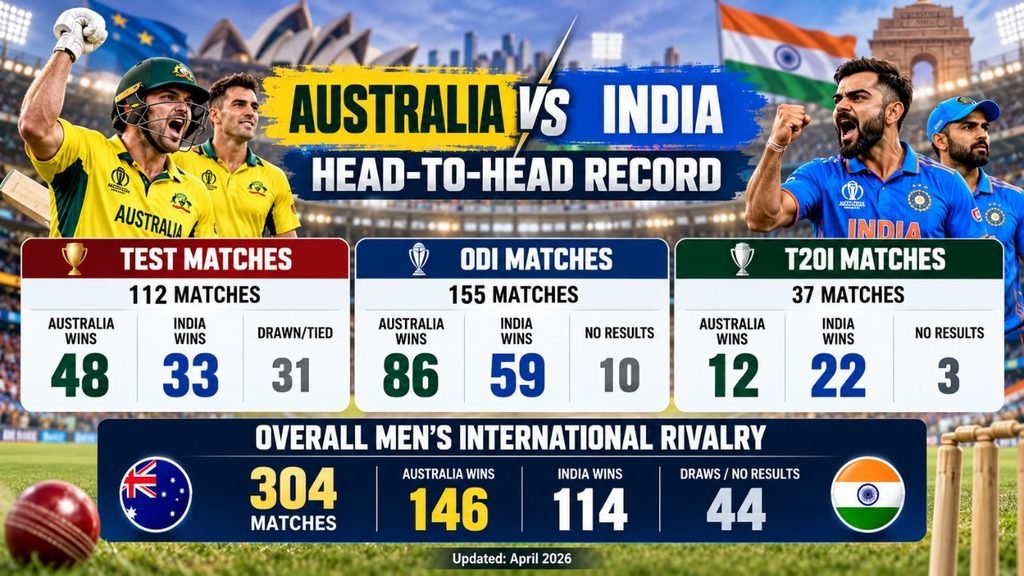
Australia v India is probably the biggest rivalry in international cricket take you pick. The number of matches for all three international formats exceeds 300 in their contests.
| Format | Matches | Australia Wins | India Wins | Draw/No Result |
| Tests | 112 | 48 | 33 | 31 |
| ODIs | 155 | 86 | 59 | 10 |
| T20Is | 37 | 12 | 22 | 3 |
Which there by these figures shows Australia had success over times in Tests and ODIs but India are Prince of all T20I formats.
One-Day International rivalry has given us some of the most classic games in the history of international cricket. India have waged war with Australia on 153 different occasions, losing 86 of those games and winning just 59 according to the head-to-head record over the years. A further 10 matches across the season ended without a result.
| ODI Statistic | Record |
| Matches | 155 |
| Australia wins | 86 |
| India wins | 59 |
| No result | 10 |
| Ties | 0 |
Recent ODI results have demonstrated how quickly the momentum can change between the two sides.
The Test rivalry dates back to 1947 and has developed into one of the most important contests in the longest format.
| Test Statistic | Record |
| Matches | 112 |
| Australia wins | 48 |
| India wins | 33 |
| Draw/Other results | 31 |
Australia currently hold the historical advantage in Test wins, although India have achieved several memorable Test victories in Australia in recent years.
India have a stronger overall T20I record against Australia.
| T20I Statistic | Record |
| Matches | 37 |
| India wins | 22 |
| Australia wins | 12 |
| No result/Other | 3 |
We witnessed many high-scoring clashes and nail-biting finishes in the T20I rivalry.
The exciting Indian cricket scorecard for the Australian men’s cricket team vs India national cricket team match is always more enjoyable when put in the context of the wider competition.
| Statistic | Information |
| First Test meeting | 1947 |
| First ODI meeting | 1980 |
| First T20I meeting | 2007 |
| Total meetings across formats | 300+ |
| ODI leader historically | Australia |
| Test leader historically | Australia |
| T20I leader historically | India |
It has featured major ICC clashes, ranging from World Cup finals to Champions Trophy fixtures, T20 WC encounters and the World Test Championship final.
Because matches between the Australian men’s cricket team and India national cricket team typically involve high-quality international players, this match scorecard is highly sought after.
You are bred on the fact that your two teams always give quality pace bowlers, batsmen with technique, athletic fielders and experienced allrounders. And then there is the difference in playing conditions which adds a further flavour to this rivalry.
A scorecard is more than the final result for fans. It keeps track of runs, wickets, partnerships, strike rates, bowling figures, extras and fall of wicket progress in the match.
India defeated Australia by nine wickets in the third ODI on 25 October 2025. Australia scored 236 all out, while India reached 237/1.
Australia and India have played 155 ODIs, with Australia winning 86 and India winning 59. Ten matches ended without a result.
Australia have the historical advantage in Tests, with 48 wins compared with India’s 33 from 112 meetings.
India have the stronger T20I record, with 22 wins compared with Australia’s 12 from 37 matches.
A detailed scorecard generally includes each batter’s runs and balls, bowling figures, extras, fall of wickets, team totals, and the final result. Official cricket match centres are useful for checking complete scorecard details.
Also Read: England Cricket Team vs Indian National Cricket Team Timeline
Sri Lanka National Team vs Indian National Cricket Team Timeline