 11
11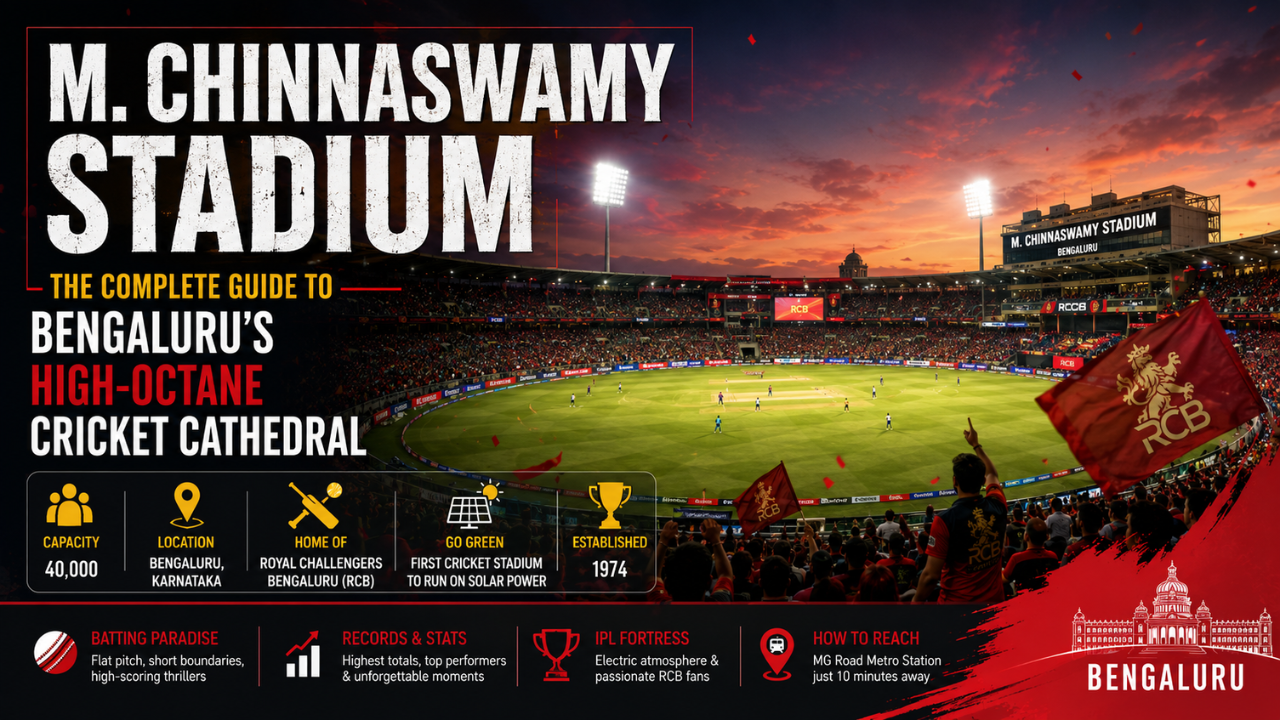
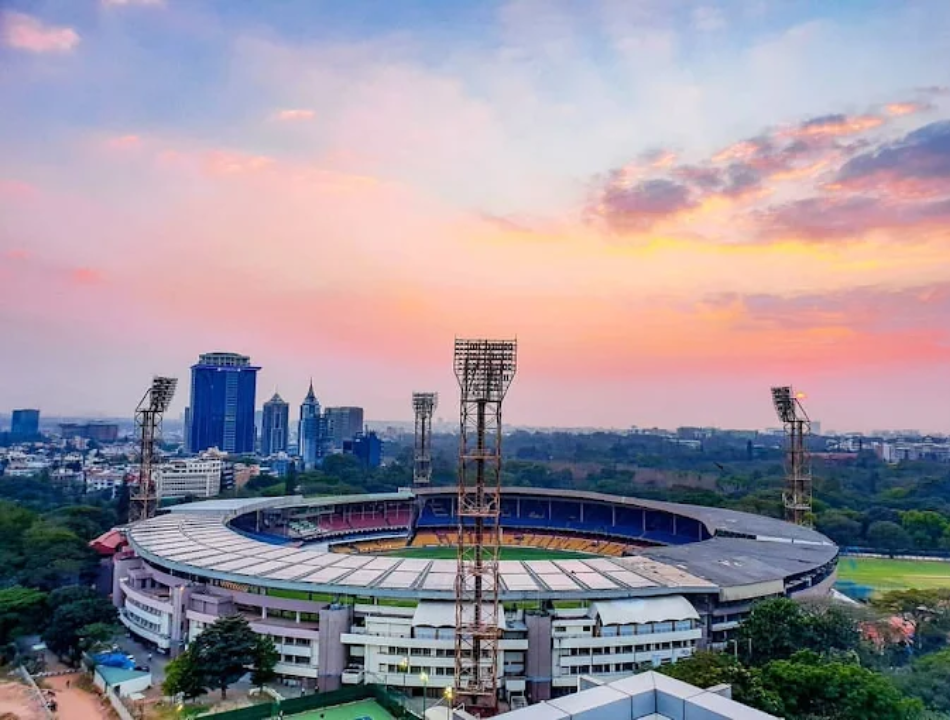
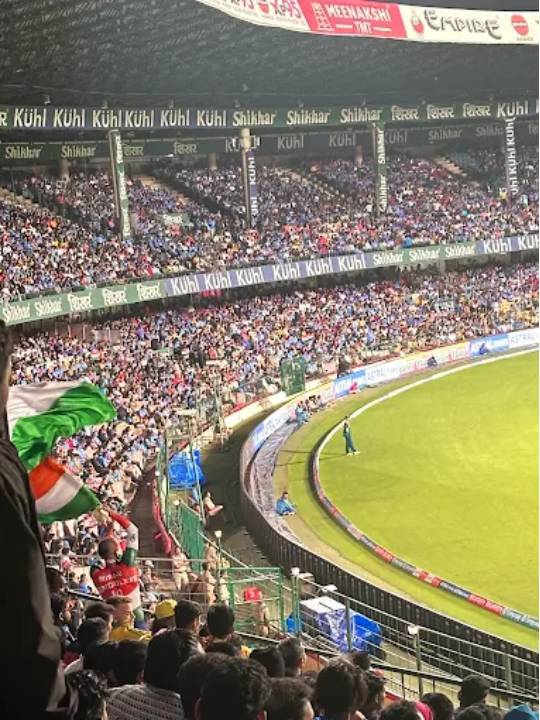
Not many cricket stadiums in India have the same buzz associated with them as the M. Chinnaswamy Stadium. Nestled in the heart of Bengaluru, wedged between the greenery of Cubbon Park and the hustle and bustle of MG Road, this stadium has earned an identity that is so much more than another venue on the cricket calendar. There is noise, there is speed, and it nearly always leads to running. But for Royal Challengers Bangalore followers, this ground is sacred soil, the turf on which Virat Kohli constructed his legend and where Chris Gayle once played an inning that draws whispers in awed disbelief.
This guide covers everything you need to know about the M. Chinnaswamy Stadium, from its history and run-scoring reputation (backed by science), through records across formats, to practical information for anyone planning on going there to see a game in person.
| Detail | Information |
| Full Name | M. Chinnaswamy Stadium |
| Earlier Name | Karnataka State Cricket Association (KSCA) Stadium |
| Named After | Mangalam Chinnaswamy Mudaliar, former KSCA and BCCI President |
| Location | Cubbon Park Road, Bengaluru, Karnataka |
| Construction | Foundation laid in 1969; built through 1970 |
| First International Fixture | India vs West Indies, November 1974 |
| Owned By | Government of Karnataka |
| Operated By | Karnataka State Cricket Association (KSCA) |
| Capacity | 40,000 |
| IPL Home Team | Royal Challengers Bengaluru |
| Ends | Pavilion End and BEML End |
| Formats Hosted | Test, ODI, T20I, IPL, First-Class cricket |
| Elevation | 920 metres above sea level |
| Floodlights | Installed in 1996, ahead of the Wills World Cup |
| Standout Feature | First cricket ground in the world to run on solar power |
The history of M. Chinnaswamy Stadium dates back to the late 1960s, when the Karnataka government laid its foundation stone in 1969, and construction work commenced a year later. This venue played its first first-class match in the 1972-73 Ranji Trophy season, and a few years later, it came onto the international stage when India hosted West Indies for a Test series in November 1974.
In those earlier years, the ground was otherwise known only by its administrative name, the Karnataka State Cricket Association Stadium. It changed after it was renamed after Mangalam Chinnaswamy Mudaliar, a lawyer who co-founded the Mysore State Cricket Association and went on to become President of BCCI, who was born in Mandya. It was both a salute to a man who had influenced Karnataka cricket administration and also an attempt to bestow on the ground an identity reflective of the cresting stature it was steadily acquiring.
There is a layer of cricketing folklore associated with this venue which fans like to recount. The West Indian legends Sir Viv Richards and Gordon Greenidge played their Test debuts on the same day at M. Chinnaswamy Stadium in 1974, an element that lends a sliver of history to the place. Two decades later, in 2008 and recall Sachin Tendulkar was a witness to unveil the same wall commemorating Rahul Dravid’s remarkable milestone of becoming the first player to cross 10,000 runs in both Test and ODI cricket, another moment in time that made this venue part of sporting memory.
Also Read: Optus Stadium Guide | HPCA Stadium, Dharamshala
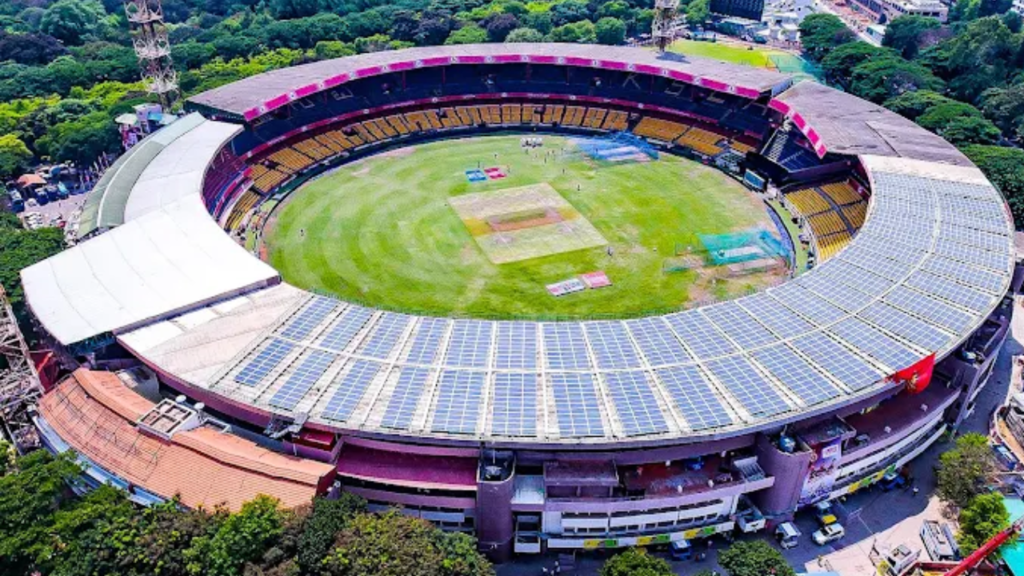
However, what separates the M. Chinnaswamy Stadium from most other cricket grounds in the world today is not a batting record but sustainability. The Karnataka State Cricket Association launched its ‘Go Green’ initiative in 2015, installing solar panels on parts of the stadium roof to supply power for its operations. With this, Chinnaswamy became the first cricket stadium anywhere in the world to run largely on solar energy, a claim that the ground remains proud of.
The push for sustainability didn’t end there. In 2016, a water-purifying plant came in addition, and in January of 2017 the advanced aeration and drain system was installed. On the field, that drainage upgrade has also provided one very practical benefit too: there are far fewer games at Chinnaswamy now affected by a waterlogged outfield, while the system has also helped regulate and conserve water usage more broadly. All these moves have helped to make the ground something of a flagship venue for environmentally responsible cricket infrastructure, and its image reaches far beyond the rope.
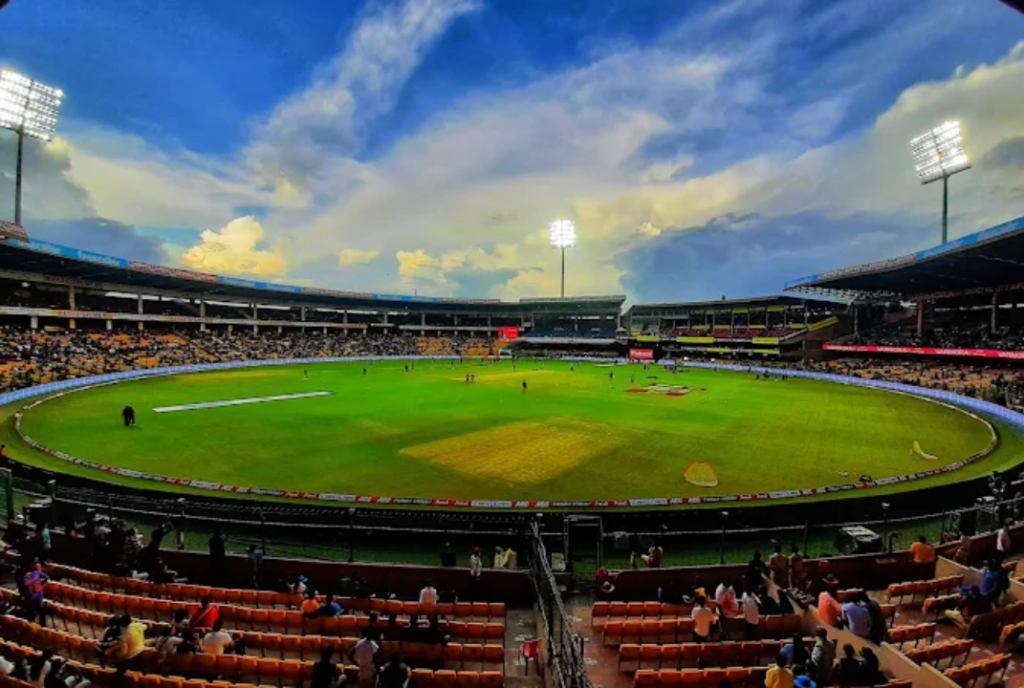
Ask any bowler who has been playing here, they will say the same thing more or less: ‘The pitch at the M. Chinnaswamy Stadium hardly works in your favour’ The pitch is well known for being true and flat, with what many consider one of the quickest outfields in Indian cricket and squarer boundaries than those available at the majority of international venues. Part ground preparation, part geography, it consistently produces big scores.
In fact, altitude comes into play in a scientific way here as well. Bengaluru’s lofty air, at around 920 metres above sea level, provides less drag for a shot in flight. In practical terms, that translates to a six at Chinnaswamy which would have comfortably been taken just in front of the rope had it been at sea-level venues. It´s one of the less known but more crucial reasons this ground has earned such a high-scoring reputation over the years. The pitch too plays a little different, depending on the format and also the stage of the game:
Test cricket: As a rule, the opening three days are for batters on a flat, true deck, but again the new ball gives seamers much more in the first session each day. Pitch Starts to Wear: From Day 4 onwards, with the pitch gradually wearing out, spinners will get more assistance here.
ODI cricket: It is not uncommon for scores to exceed 300 here, as the ground also features one of the highest average first innings totals in ODI cricket; approximately 262.
T20 & IPL cricket: This is the point where Chinnaswamy really begins to earn its place as India’s best T20 batting paradise. The average IPL first innings total here ranges from around 168 to 181, and totals above 200 are practically the norm. The highest ever team total achieved at the venue is Sunrisers Hyderabad’s 287/3 against RCB in 2024 and that remains the benchmark for pure carnage.
| Boundary | Distance |
| Straight (Pavilion End) | 70-75 metres |
| Straight (BEML End) | 68-72 metres |
| Square Leg | 61 metres |
| Cover/Point | 61-63 metres |
It sits up towards the northern edge of the Deccan Plateau, meaning it has a more moderate temperature than India’s major cities – and that extends to the stadium. Even during the height of summer between March and May, conveniently coinciding with the IPL season, temperatures around the place are usually between 25°C and 34°C, appreciably less severe than what fans suffer at different Indian locations. Cooler evenings also ensure that day-night fixtures are genuinely pleasant to watch.
The rains start in June and run until they fade by September, the after-effects seen when Test cricket returns in October and November, leaving a slightly wetter field that can slow down a pitch usually full of runs. For those who want to go specifically for the cricket, and not just because it is India, October to February usually offers the best conditions, often clear skies and mild temperatures during the day.
Also be aware of dew in the evenings when it comes out. When the temperature drops after sunset, dew will settle on the outfield and wet conditions will make it difficult for bowlers, particularly spinners, to grip the ball. It explains one reason why teams have often had a statistical advantage when chasing at Chinnaswamy in IPL matches; dew makes the ball come onto the bat more and gives the chasing side a qualified advantage, even while defending a modest target.
| Record | Detail |
| Highest Team Total | 287/3 – SRH vs RCB, 2024 |
| Lowest Team Total | 82 – RCB vs KKR, 2008 |
| Highest Individual Score | 175* – Chris Gayle (RCB) vs Pune Warriors, 2013 |
| Best Bowling Figures | 4/9 – Samuel Badree (RCB) vs MI, 2017 |
| Fastest Century | 30 balls – Chris Gayle vs Pune Warriors, 2013 |
| Highest Successful Chase | 213/9 – LSG vs RCB, 2023 |
| Average First Innings Score | 168-181 |
| Most Runs at Venue | Virat Kohli – 3,100+ runs |
| Most Sixes at Venue | Chris Gayle – 127 sixes in 44 innings |
| Total IPL Matches Hosted | 96+ |
| Teams Batting First – Win % | 43% |
| Teams Batting Second – Win % | 54% |
| Record | Detail |
| Tests Played | 24 |
| India Wins | 9 |
| Opposition Wins | 6 |
| Draws | 9 |
| Highest Team Total | 626/9d – India vs Pakistan, 2007 |
| Lowest Team Total | 103 – Afghanistan vs India, 2018 |
| Highest Individual Score | 267 – Younis Khan (PAK) vs India, 2005 |
| Best Bowling (Innings) | 8/50 – Nathan Lyon (AUS) vs India, 2017 |
| Best Bowling (Match) | 11/224 – Harbhajan Singh vs Australia, 2004 |
| Highest Successful Chase | 262/5 – India vs New Zealand, 2012 |
| Record | Detail |
| ODIs Played | 30+ |
| Highest Team Total | 401/6 – New Zealand vs Pakistan, 2023 |
| Lowest Team Total | 156 – England vs Sri Lanka, 2023 |
| Highest Individual Score | 209 – Rohit Sharma (IND) vs Australia, 2013 |
| Best Bowling Figures | 5/31 – Yuvraj Singh (IND) vs Ireland, 2011 |
| Highest Successful Chase | 329/7 – Ireland vs England, 2011 |
| Average First Innings Score | 262 |
The 2026 season once again proved the ground’s status as a fortress for Royal Challengers Bengaluru. RCB deployed Chinnaswamy as its sole home ground throughout the season, and it was one of the club’s strongest home campaigns in IPL history; RCB went undefeated at the venue throughout their league stage run en route to getting back to its title defense.
As expected, the fixtures at the Chinnaswamy in 2026 produced plenty of pyrotechnics. Virat Kohli scored a breezy half-century in the chase of 151, wrapping up the second match of RCB’s home leg with several overs to spare as Sunrisers Hyderabad struggled again, and that served to remind why this particular ground has been so crucial in his career. It further cemented Chinnaswamy’s reputation as one of world cricket’s biggest, flattest, record-shedding venues.
| Mode | Details |
| Metro | MG Road Metro Station (Green Line) – roughly a 10-minute walk |
| By Road | Located on Cubbon Park Road; reachable via MG Road and Queen’s Road |
| By Rail | Bengaluru City Railway Station – approximately 4 km away |
| By Air | Kempegowda International Airport – about 40 km away via the elevated expressway |
| Parking | Limited within the stadium premises; using the metro is strongly advised on match days |
Also Read: Rajiv Gandhi International Stadium | Wankhede Stadium
M. Chinnaswamy Stadium is not just another cricket stadium; it is one of the defining grounds in world cricket. With an electric atmosphere, a batting-friendly pitch, a passionate RCB fanbase and its historic pros and cons, it is a ground that bears a tapestry of memories across formats: Test cricket, ODIs, T20Is, and the IPL. It is a batter’s paradise, a bowler’s graveyard because it has short boundaries and high altitude combined with a quick outfield.
Apart from cricket, it has established benchmarks in sustainability with its green initiatives as well. Whether you’re a cricket lover and follow IPL regularly, or a visitor in Bengaluru, M. Chinnaswamy Stadium is one place that you must know about as it encapsulates the very spirit of sporting history and innovation with excellence.
The Anil Kumble End (formerly known as BEML End)and the Rahul Dravid End (formerly known as BEML End).
Yes, it is famous for its high-scoring matches with a flat pitch and short boundaries.
It is known for solar power and eco-friendly sustainable practices.
The highest IPL number here is 287/3 by Sunrisers Hyderabad vs RCB in 2024.
It hosted its first international match on 22 November 1974, a Test between India and the West Indies.