
 11
11
Rawalpindi Cricket Stadium has something that just fascinates you. Unlike Karachi’s National Stadium or Lahore entrusted with the enormous social grandeur of its Gaddafi, it is modest. What it does have is intimacy, the proximity of stands and boundary rope such that every blow feels personal, and a cricketing past thick enough to fill several volumes. This is the same place where Shoaib Akhtar first played for Pakistan internationally and would get the legendary name, Rawalpindi Express.
Here, Rahul Dravid made a dominating 270, which is the highest individual Test score at the ground. It was the ground that saw Test cricket return to Pakistan in 2019 for the first time in a decade of security-inspired absence, and where Pindi became very literally centre stage for world attention thanks to the 2025 ICC Champions Trophy. This written piece details the history, pitch, records and everything you need to know about one of Pakistan’s go-to cricket grounds in this comprehensive 2026 guide.
| Category | Details |
| Stadium Name | Rawalpindi Cricket Stadium |
| Location | Stadium Road, Shamsabad, Rawalpindi, Punjab, Pakistan |
| Also Known As | Pindi Stadium / The Pindi Cauldron |
| Established | 1992 |
| Managed By | Pakistan Cricket Board (PCB) |
| Capacity (2026) | ~28,000 (post-2025 expansion) |
| Home Teams | Pakistan national team; Islamabad United (PSL) |
| Bowling Ends | Pavilion End, Shell End |
| First International Match | January 19, 1992 (Pakistan vs Sri Lanka, ODI) |
| First Test Match | 1993 (Pakistan vs Zimbabwe) |
| Famous Milestone | Test cricket returned to Pakistan here in 2019 vs Sri Lanka |
| Notable Fact | Shoaib Akhtar’s international debut venue |
The first international match at the Rawalpindi Cricket Stadium was on January 19, 1992 when Sri Lanka played Pakistan in an ODI. It took the opening match for the venue to cement its place as one of more dependable hosts on Pakistan’s domestic circuit, hosting Quaid-e-Azam Trophy matches, National T20 Cup fixtures and a fairly consistent stream of international appointments.
That made Rawalpindi stadium the home ground and international debut ground of world’s fastest bowler, Shoaib Akhtar whose nickname was later known as the Rawalpindi express as a result. That nickname could have had its roots in the man himself, but it also became part of the venue and lore around one ground that few Pakistan venues can hope to compete with.
The Rawalpindi Cricket Stadium experienced arguably the most emotive period of its modern history in 2019/20. This was the venue of first Test staged in Pakistan since Test cricket returned to Pakistan for the two-match Test series against Sri Lanka held in Sri Lanka from 11–15 December 2019. This was also the first Test match in Pakistan since 2009 after the Sri Lanka team’s bus was attacked by terrorists in Lahore. The return was here, in an ivy-clad ground full of supporters who had waited two years for this moment and the day had an importance over cricket.
The Pakistan Cricket Board refurbished the ground to international standards for the 2025 ICC Champions Trophy, with expenses ultimately rising to PKR 18 billion due to further improvements. The main pavilion and media boxes were also refurbished, as well as seating and 350 LED floodlights, along with hospitality boxes. But the fixtures involving Pakistan, Australia, South Africa and New Zealand in the Champions Trophy, all group-stage matches, attracted full houses and showed the ground was ready for global sporting events.
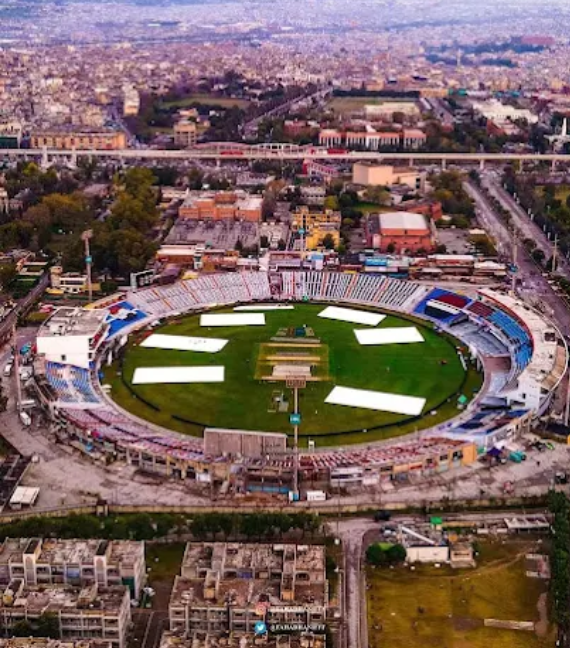
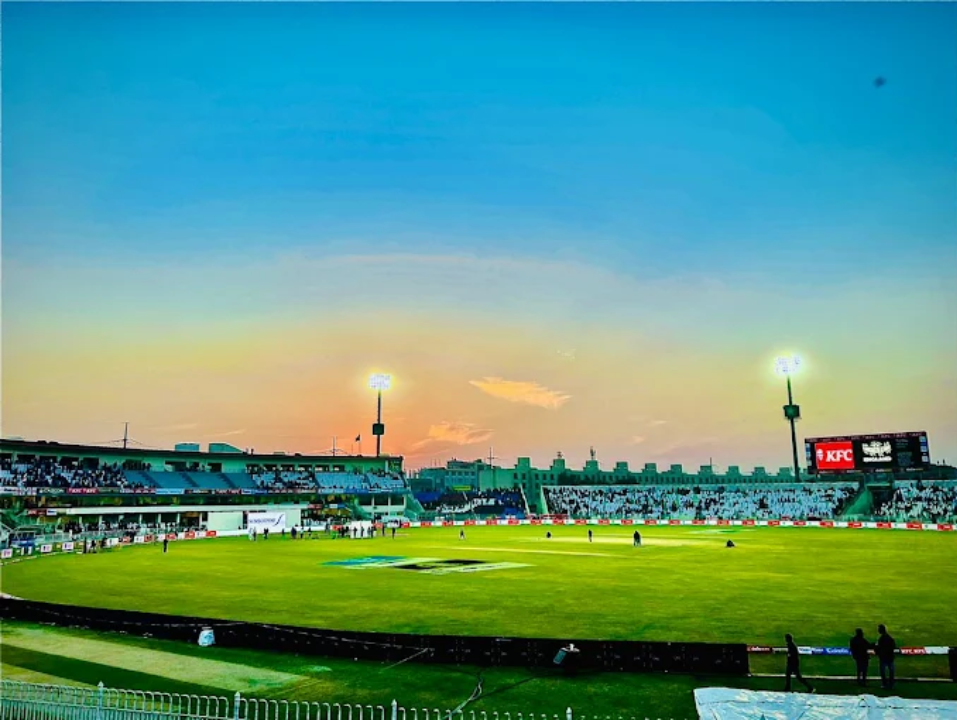
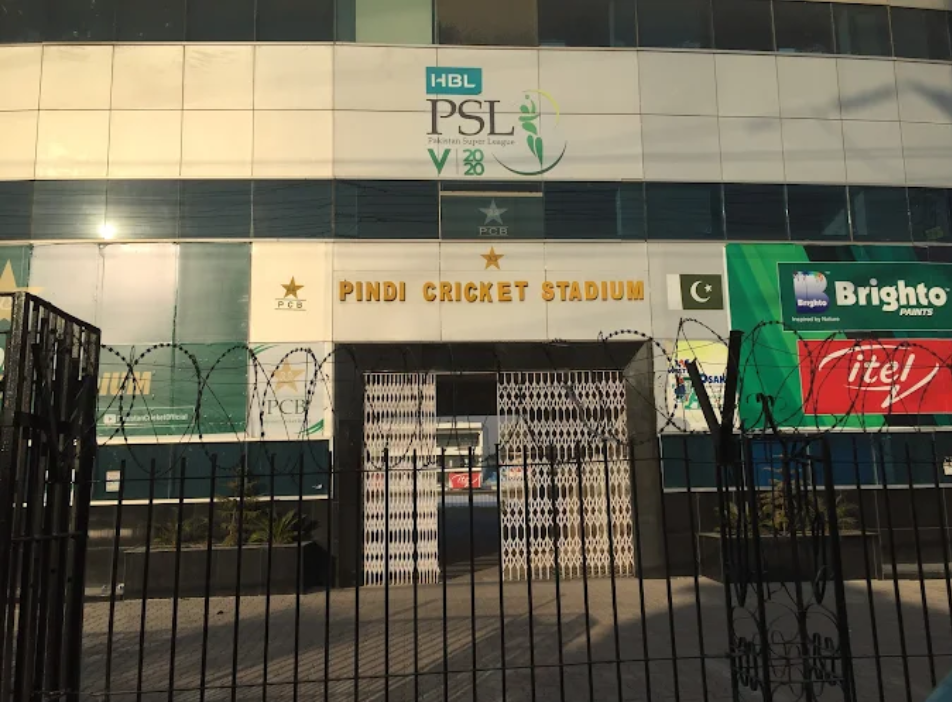
With expansion projects completed in 2025/2026, the Rawalpindi Cricket Stadium has a total capacity of roughly 28,000 including an more than 15,000 permanent seats and about another 13,000 from new temporary stands and upgraded hospitality wings. Prior to these renovations, the established permanent capacity was around 15,000.
Over its course, the expansion was planned to keep the famed coziness of the ground intact. The enclosures are erect along the boundary ropes, so that you can easily get up close to the action, one of Pakistan’s loudest and most intimate venues. For visiting teams, the noise and atmosphere that comes with it is one of the toughest on an ever-increasingly demanding subcontinent circuit: just 15 metres from the rope sits the front row of the general stands.
Also Read: M. Chinnaswamy Stadium | Optus Stadium
The Rawalpindi Cricket Stadium pitch is also famous for its flat nature and a batter’s paradise. Until this season, wickets had simply borne no help for bowlers; teams have been comfortably chasing huge targets (i.e 200+) with ease.
Within the early levels of the sport, a pitch traditionally assists quick bowlers and can carry and motion beneath lights. In the initial stages, the surface is a hot cake, offering something for everyone, gradually settling down and allowing batsmen to capitalise on raw pace and extract runs in partnerships.
| Format | Characteristics | Who Benefits |
| Test Matches | Flat and true for first three days; some turn from Day 4 onward | Batters early; spinners late |
| ODIs | Neutral early with new ball; increasingly batting-friendly | Teams batting second |
| T20Is / PSL | High-scoring; pace early, spin through middle | Batters; explosive finishers |
The regular bounce associated with the 2026 hybrid pitch is also a step up from those used in previous seasons, while compact 65-metre square boundaries are designed to ensure 200-plus scores are the rule and not exception at T20 level.
| Boundary | Distance |
| Straight Boundaries | 70-72 metres |
| Square Boundaries | 65-68 metres |
India’s Rahul Dravid scored the current highest Test match individual score at the venue – a marathon 270 against Pakistan. Made in April 2004, it still stands not only as the most celebrated individual innings in the Test history of this ground but also as a reminder of Dravid’s plodding techniques against one of Pakistan’s most attack-armed bowling lines-ups of that era.
The highest Test partnership at this venue is 323 between Pakistan pair Aamer Sohail and Inzamam-ul-Haq for the second wicket against West Indies in November 1997.
England brought up 657 in a Test match here back in 2022, the best team score recorded here but emblematic of how favourable this surface can be across sessions if conditions align.
| Category | Detail |
| Highest Team Total | 657 – England vs Pakistan, 2022 |
| Highest Individual Score | 270* – Rahul Dravid (India) vs Pakistan, 2004 |
| Highest Partnership | 323 – Aamer Sohail & Inzamam-ul-Haq vs West Indies, 1997 |
| Best Bowling Figures (ODI) | 5/20 – Saqlain Mushtaq (Pakistan) |
| Lowest ODI Total | 104 – Zimbabwe vs Sri Lanka |
| Tests Hosted | 16 |
| Tests Won Batting Second | 9 |
| Tests Won Batting First | 3 |
| Tests Drawn | 4 |
Out of the ODI matches played at the ground, 12 wins first-innings and 15 in second-innings is a clear pattern that shows how teams chasing have been rewarded, especially as the pitch flattens out through an innings.
Sachin Tendulkar’s 141 off 135 in the 2nd ODI of the 2004 Samsung ODI series stands tall as other Indian batters battled against Pakistan’s pace and spin attack. It ranks as one of the most iconic individual ODI innings at this venue.
Multan Sultans had posted 262/3 here, which is the highest team total in a PSL match at this venue and one of the all-time high totals in PSL’s long history. New Zealand have the lowest T20I score at the venue having been bowled out for 90 when they took on Pakistan.
The PSL 11 (2026) season included 11 matches at the Rawalpindi Cricket Stadium, with the new tournament-opening blockbuster clash between Islamabad United and Lahore Qalandars on April 11, 2026. It was the main and central home ground of Islamabad United as well as Peshawar Zalmi.
There is a 60% chance for teams chasing at night here now thanks to the dew factor, which puts captains who bats first in a tactical bind pre-toss in 2026. As the evening moisture settles on the outfield, it makes gripping the ball more difficult for bowlers in the second innings and pushes a batter towards his limit with dispatching the ball.
Shoaib Akhtar’s Debut (1997): At this ground, the young Rawalpindi fast bowler made his Test debut in 1997 and went on to deliver the fastest ball ever bowled in cricket. The stadium is permanently associated with him, the Shoaib Akhtar Enclosure in the redeveloped 2026 ground is named plainly after him.
Return of Test Cricket in Pakistan (2019): This ground got to host the inaugural Test when Sri Lanka, who were the first country to tour Pakistan as a Test-playing nation since the 2009 terrorist attack in Lahore. The encounter had almost a ritualistic significance apart from its sporting context.
Champions Trophy 2025: This was where you were introduced to three group-stage matches, which put the eyes of the world on these shores, and some of the loudest, most fanatical crowds of the tournament were enjoyed by a home Pakistan team.
Rawalpindi Cricket Stadium, situated off Stadium Road in the Shamsabad vicinity of Rawalpindi, 10 km from Islamabad’s centre and just a twenty-minute drive into the capital for travelling fans from either of the two cities.
| Transport Mode | Details |
| Rawalpindi–Islamabad Metrobus | Shamsabad Station is adjacent to the stadium |
| By Road | Stadium Road off 6th Road in Rawalpindi |
| From Islamabad Airport | Approximately 25-30 km, 30-40 minutes by road |
| Parking | Available near Stadium Road with additional overflow near 6th Road |
Also Read: HPCA Stadium | Rajiv Gandhi International Stadium
The Rawalpindi Cricket Stadium will be in the best shape of its life, and you can take that literally: 28,000-seater, LED-illuminated, hybrid-pitch futures studied and London Test grants battled over in one of the decade marquee tournaments. The infrastructure isn’t what makes it long-lasting, though.
The street-food culture outside the gates, the Margalla Hills on a clear day, the noise that rises like nowhere else in Pakistan when a home side wicket falls at night and history soaking through every inch of the ground, from Shoaib Akhtar’s first delivery in anger to Test cricket’s return in 2019. This pitch is more than a place to play. It is the opportunity to experience everything cricket has to offer and well worth every serious cricket fans bucket list.
The stadium has a seating capacity of around 28,000 after its 2025-26 expansion.
A Test match at this venue was played as the inaugural ODI test on 19 January 1992.
Rahul Dravid with an unbeaten 270 against Pakistan in 2004.
It was his home ground and the same site of his international debut – earning him the title “Rawalpindi Express”.